- Now Open in Finacial District and Kondapur
- Customer Care- 10AM to 7PM
- +91-9933332442

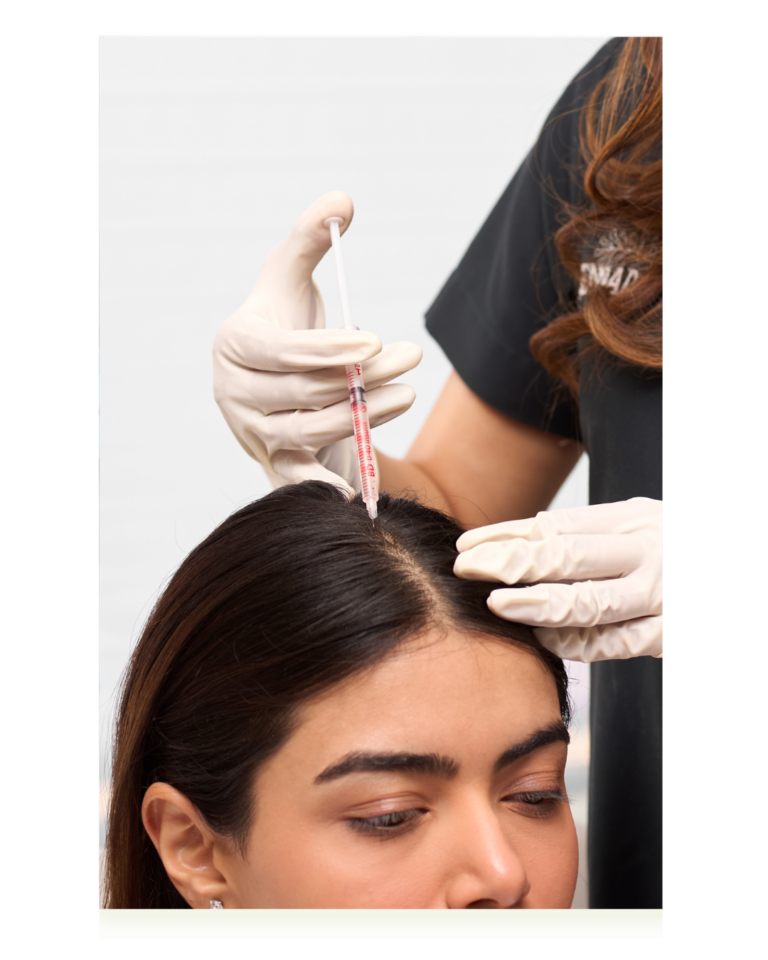
Growth Factor Concentrate therapy for natural hair rejuvenation. Concentrated growth factors from your own blood. Stimulates dormant follicles, promotes regrowth, increases thickness. Superior to traditional PRP. Effective for pattern baldness, thinning, overall hair health.
What is GFC Hair Treatment?
GFC (Growth Factor Concentrate) is an advanced hair restoration therapy that extracts and concentrates growth factors from your own blood to stimulate hair follicles, promote regrowth, and improve overall hair health. Unlike traditional PRP (Platelet-Rich Plasma) which contains platelets, red blood cells, and white blood cells, GFC isolates only the pure growth factors—the active molecules responsible for tissue repair and regeneration—removing cellular components that can cause inflammation or reduce efficacy.
The process involves drawing small blood sample, processing through specialized centrifugation and filtration to extract concentrated growth factors (PDGF, VEGF, EGF, FGF, IGF among others), then injecting this golden-colored serum directly into scalp at follicle level. These growth factors activate dormant hair follicles in telogen phase, stimulate anagen (growth) phase, strengthen existing hair shafts, improve scalp circulation and nutrient delivery, reduce inflammation inhibiting growth. Results: visible increase in hair density, thickness, regrowth in thinning areas, reduced shedding, improved hair quality and texture. Ideal for androgenetic alopecia (pattern baldness), diffuse thinning, telogen effluvium, overall hair quality enhancement. Protocol: typically 4 sessions spaced 3-4 weeks, maintenance every 4-6 months sustaining results long-term.
GFC Hair Treatment at Zennara delivers concentrated pure growth factors for maximum hair restoration efficacy. Natural, autologous therapy using your body’s own healing mechanisms.

Benefits of GFC Hair Treatment
Benefits of GFC Hair Treatment
Awakens dormant follicles, promotes regrowth
Strengthens hair shafts, improves diameter
More hair growth, reduced balding areas
Superior to PRP, no inflammatory cells
Your own blood, no rejection risk
Improved texture, shine, health
Meet the masters of aesthetics
M.D. (Dermatology, Venereology & Leprosy),
F.C.P.S. (Dermatology & Venereology) D.D.V
(CPS, Gold Medallist), M.B.B.S.

M.D. (Dermatology, Venereology & Leprosy),
F.C.P.S. (Dermatology & Venereology) D.D.V
(CPS, Gold Medallist), M.B.B.S.

M.B.B.S, M.D. Dermatology and
Fellowship in Cosmetology
M.B.B.S., M.D. in Dermatology,
Venereology & Leprology

M.B.B.S., M.D. in Dermatology,
Venereology & Leprology

M.B.B.S , M.D. Dermatology, Venereology & Leprosy (Gold medal)
M.D. (Dermatology, Venereology & Leprosy), F.C.P.S. (Dermatology & Venereology) D.D.V (CPS, Gold Medallist), M.B.B.S.
M.D. (Dermatology, Venereology & Leprosy), F.C.P.S. (Dermatology & Venereology) D.D.V (CPS, Gold Medallist), M.B.B.S.
M.B.B.S, M.D. Dermatology and
Fellowship in Cosmetology
M.B.B.S., M.D. in Dermatology,
Venereology & Leprology
M.B.B.S., M.D. in Dermatology,
Venereology & Leprology
M.B.B.S , M.D. Dermatology,
Venereology & Leprosy (Gold medal)
Celebrity Love for Zennara
Celebrity Love for Zennara

Zennara was such a good, relaxing experience!
I try a lot of different facials from many places, and I can say that the ones at Zennara are my favourite and get my face seriously glowing.
“Zennara was such a good, relaxing experience! I try a lot of different facials from many places, and I can say that the ones at Zennara are my favourite and get my face seriously glowing.”
Zennara was such a good, relaxing experience!
I try a lot of different facials from many places, and I can say that the ones at Zennara are my favourite and get my face seriously glowing.

“I love the opinions and suggestions given by the panel of doctors and the wonderful team here at Zennara”

“Right from the welcoming staff to the incredible team of doctors they have here. I truly feel well cared for and can confidently say I’m a very happy customer.”

“Come to Zennara—where every visit is a step closer to inner peace, and the power of zen gives you a natural, radiant glow.”
“Zennara was such a good, relaxing experience!
I try a lot of different facials from many places, and I can say that the ones at Zennara are my favourite and get my face seriously glowing.”
“I love the opinions and suggestions given by the panel of doctors and the wonderful team here at Zennara”
“Right from the welcoming staff to the incredible team of doctors they have here. I truly feel well cared for and can confidently say I’m a very happy customer.”
“Come to Zennara—where every visit is a step closer to inner peace, and the power of zen gives you a natural, radiant glow.”
GFC represents advancement over traditional PRP technology. Both start with your blood, but processing and final product differ significantly: PRP (Platelet-Rich Plasma) contains platelets plus red blood cells, white blood cells, plasma proteins—mixture of beneficial and potentially inflammatory components. Platelets release growth factors but also inflammatory cytokines. Cellular debris can reduce absorption. GFC (Growth Factor Concentrate) isolates only pure growth factors removing all cellular components. Advanced filtration extracts concentrated PDGF, VEGF, EGF, FGF, IGF-1, TGF-beta without platelets, RBCs, WBCs. Key advantages: Higher growth factor concentration (3-5x more concentrated). No inflammatory cells means less scalp irritation, better tolerance. Superior bioavailability—pure factors absorb more efficiently into follicles. Consistent potency—standardized concentration vs. PRP variability. Longer shelf stability—can be activated when needed. Golden appearance vs. PRP’s red-yellow color indicates purity. Clinical outcomes: Studies show GFC produces better hair density increase, faster visible results, higher patient satisfaction, less post-treatment inflammation compared to traditional PRP. Analogy: PRP is crude oil, GFC is refined petroleum—same source, purified product. Cost consideration: GFC typically more expensive than PRP (₹8,000-15,000 per session vs. ₹5,000-10,000 PRP) due to advanced processing technology. Worth premium for superior efficacy especially in stubborn cases. Bottom line: Both work, but GFC offers refinement addressing PRP’s limitations through scientific advancement.
GFC most effective for conditions where hair follicles still exist but are weakened, miniaturized, or dormant: Androgenetic Alopecia (Pattern Baldness): Male pattern baldness (receding hairline, crown thinning). Female pattern hair loss (diffuse thinning, widening part). Best in early-moderate stages (Norwood 2-4 men, Ludwig 1-2 women). Can stabilize progression, thicken miniaturized hairs, improve density. Advanced baldness (Norwood 6-7) limited benefit—few follicles remain to stimulate. Diffuse Thinning: Overall reduction in hair density without specific pattern. Common post-pregnancy, hormonal changes, stress, nutritional deficiency. GFC excellent for this—awakens follicles prematurely entering telogen, strengthens existing growth. Telogen Effluvium: Excessive shedding triggered by stress, illness, surgery, medications. GFC accelerates recovery, shifts follicles back to anagen phase faster. Complements addressing underlying trigger. Traction Alopecia (Early): Hair loss from tight hairstyles, extensions, chemical treatments. If follicles not permanently damaged, GFC can revive them. Combination with lifestyle changes crucial. Overall Hair Quality: Even without significant loss, GFC improves hair thickness, strength, growth rate, shine. Popular for cosmetic enhancement maintaining youthful hair. What GFC cannot treat: Alopecia Areata (autoimmune): Requires immunosuppressive therapy, GFC adjunctive only. Scarring Alopecias: Permanent follicle destruction (lichen planopilaris, frontal fibrosing alopecia)—no follicles to stimulate. Complete Baldness: Totally bald areas lacking follicles—no substrate for growth factors to act upon. Hair transplant better option. Ideal candidate profile: Early hair loss with existing miniaturized follicles visible. Thinning but not complete baldness. Willingness to commit to series (4 sessions) plus maintenance. Realistic expectations—improvement, not miracle cure. Combined approach: Many combine GFC with minoxidil (topical growth stimulant), finasteride (DHT blocker if male), supplements (biotin, iron if deficient), low-level laser therapy. Comprehensive strategy addressing hair loss from multiple angles maximizes outcomes. Consultation determines suitability—trichoscopy examination reveals follicle status guiding candidacy.
Moderate discomfort during injection phase, well-tolerated with numbing: Blood draw: Minimally uncomfortable—standard needle prick in arm vein, quick 30-60 seconds. Similar to routine blood test. Processing time: No discomfort—patient relaxes while GFC prepared (15-20 minutes). Scalp injections: This is main discomfort source. Without numbing: Pain level 5-7 on 10-point scale. Scalp surprisingly sensitive with many nerve endings. Multiple injections (50-100+) across scalp can be quite uncomfortable. With topical numbing cream (standard): Applied 20-30 minutes before injections. Pain reduces to 2-4 on scale for most patients. Takes edge off significantly though some sensation remains. Sensation described as: Series of pinpricks, brief sharp moments. Pressure feeling as product injected. Some areas more sensitive than others (hairline, temples more tender than crown). Duration of discomfort: Only during actual injection delivery (15-30 minutes). Between injections: no pain. Pattern: prick-inject-pause, repeated systematically. Post-treatment: Mild scalp tenderness for 1-2 hours after numbing wears off. Like scalp sensitivity after tight hairstyle. Resolves quickly. No significant ongoing pain. Comparison to other treatments: More uncomfortable than: Topical applications (minoxidil), oral medications. Comparable to: Traditional PRP injections (same technique), mesotherapy injections. Less painful than: Hair transplant procedure (even with anesthesia, extensive manipulation), some laser treatments. Individual variation: Pain-sensitive individuals: May find it more challenging, can request breaks, slower pace. High pain tolerance: Many describe as “totally manageable,” “minor annoyance worth it.” Most patients fall in middle—uncomfortable but bearable for results desired. Pain management strategies: Topical numbing cream (standard approach—highly effective). Ice application pre-treatment (numbs slightly, reduces inflammation). Smaller needle gauge (30G-32G ultra-fine). Slower injection pace with breaks as needed. Oral pain reliever pre-treatment (ibuprofen) reduces inflammation sensitivity. Distraction techniques (conversation, music, breathing exercises). Honest assessment from patients: “Not pleasant but not terrible.” “Definitely felt it but numbing helped a lot.” “Worth the discomfort—results speak for themselves.” “Each session easier as you know what to expect.” If anxiety about pain: Discuss thoroughly during consultation. Can do test area first session assessing tolerance. Consider starting smaller area (hairline only) building confidence before full scalp treatment. Most who commit to series complete all sessions—discomfort brief, results motivating.
Standard protocol for optimal results: Initial series: 4 sessions spaced 3-4 weeks apart. Total duration: 12-16 weeks (3-4 months). Why 4 sessions: Hair growth cycles require time—anagen (growth) phase lasts months. Single session insufficient for sustained follicle activation. Multiple sessions provide continuous growth factor signaling ensuring follicles transition to anagen and remain there. Cumulative effect builds with each session—growth factors work synergistically over time. Session 1: Initiates follicle awakening, signals dormant cells. Session 2: Amplifies growth signals, strengthens initial responders. Session 3: Consolidates improvements, recruits more follicles. Session 4: Maximizes density gains, ensures robust anagen phase entry. Results visibility timeline: After 1-2 sessions: Minimal visible change (frustrating but normal—cellular activation occurring beneath surface). Reduced shedding may be first sign (good indicator treatment working). After 3-4 sessions (completing series): New baby hairs appearing in thinning zones (very encouraging sign). Existing hairs appearing thicker, stronger. Months 4-6 post-series completion: Significant visible density increase. Hair coverage improved in treated areas. Thicker individual hair shafts measurable. Peak results typically achieved 4-6 months after final session (hair cycles completing). Duration of results: 8-12 months typically before gradual regression begins. Individual variation significant based on: Age (younger patients longer duration). Hair loss severity (early stages maintain better). Underlying cause (hormonal imbalances may accelerate loss despite GFC). Lifestyle factors (stress, nutrition, sleep impact longevity). Genetic predisposition (strong family history faster progression). Why results not permanent: GFC doesn’t cure underlying cause of hair loss (hormones, genetics). Activates follicles but doesn’t prevent future miniaturization from DHT sensitivity. Benefits gradually diminish as natural hair loss processes resume. Maintenance protocol crucial: Every 4-6 months: Single GFC session sustains results long-term. Prevents regression to pre-treatment baseline. Some prefer every 3 months aggressive maintenance, others stretch to 6 months with acceptable gradual thinning between. Annual approach: Series of 2-3 sessions yearly instead of quarterly singles (preference-dependent). Maintenance costs: Single session: ₹8,000-15,000 depending on area. Quarterly maintenance: ₹32,000-60,000 annually (4 sessions). Biannual: ₹16,000-30,000 annually (2 sessions). Cumulative investment: Year 1 (initial series + maintenance): ₹48,000-90,000. Subsequent years (maintenance only): ₹16,000-60,000 depending on frequency. 5-year commitment: ₹1,20,000-3,50,000 total approximate. Realistic expectations: GFC slows/halts hair loss progression, improves current state, requires ongoing maintenance to preserve gains. Not one-time permanent solution. Analogous to gym membership—results maintained while actively participating. Combination approach maximizes longevity: GFC quarterly/biannually. Daily minoxidil 5% topical. Finasteride oral (men) or spironolactone (women) if appropriate. Nutritional supplements (biotin, iron, vitamins). Healthy lifestyle (sleep, stress management, nutrition). Comprehensive strategy extends results, potentially reduces maintenance frequency needed.
GFC pricing varies by provider, location, treatment area extent: Per session pricing: Partial scalp (hairline, crown specific zones): ₹12,000-15,000. Full scalp coverage: ₹13,000-18,000 per session most common. Some premium clinics: ₹15,000-25,000 per session. Initial series cost (4 sessions): Partial scalp: ₹32,000-48,000 total initial investment. Full scalp: ₹48,000-72,000 total (most patients). Package discounts: Many clinics offer series pricing 10-20% less than individual sessions. Commitment to 4-session package upfront reduces per-session cost. Example: Individual ₹15,000 x 4 = ₹60,000, Package ₹52,000 (13% savings). Maintenance costs (ongoing): Quarterly (every 3 months): ₹48,000-72,000 annually (4 sessions). Biannual (every 6 months): ₹24,000-36,000 annually (2 sessions). Cumulative multi-year investment: Year 1 (initial + quarterly maintenance): ₹96,000-1,44,000. Years 2-5 (quarterly maintenance): ₹48,000-72,000 per year. 5-year total: ₹2,88,000-4,32,000 approximate with quarterly maintenance. Factors affecting price: Technology used: Genuine GFC kits (certified, validated) vs. generic processing affects cost and efficacy. Provider expertise: Dermatologists, hair transplant surgeons charge premium for specialization. Geographic location: Metro cities higher than smaller towns. Clinic reputation: Established centers with proven results command higher fees. Treatment area extent: More injections (full scalp) costs more than targeted zones. Why relatively expensive: Specialized GFC processing kit single-use per patient (₹3,000-5,000 cost). Time-intensive procedure (45-60 minutes total including processing, injection). Skilled practitioner required (improper technique wastes product, reduces results). Ongoing research and technology development costs. Value comparison to alternatives: Minoxidil topical: ₹500-1,500 monthly, ₹6,000-18,000 annually. Requires daily application, results plateau, maintenance forever. GFC more intensive but periodic not daily. Finasteride oral: ₹300-800 monthly, ₹3,600-9,600 annually. Effective but side effects concern some men, requires daily pill. GFC no systemic side effects. Hair transplant: ₹40,000-1,50,000 one-time (permanent follicle relocation). Surgical, expensive upfront, but one-time investment. GFC less invasive, cumulative cost may approach surgical over decade. Low-level laser therapy: ₹30,000-80,000 device purchase or ₹3,000-8,000 monthly clinic sessions. Requires frequent treatments. Comparable cumulative cost to GFC. Traditional PRP: ₹5,000-10,000 per session (cheaper than GFC). But GFC more effective, may need fewer maintenance sessions achieving better results overall. Is it worth the cost? For right candidates, yes: Visible density improvement documented in photos. Halts/slows progressive hair loss saving future hair. Boosts confidence and appearance significantly. Non-surgical, natural approach avoiding systemic medications. Cumulative benefits build over years with consistent maintenance. May not be worth it if: Very advanced baldness with minimal follicles (transplant better). Very tight budget unable to commit to maintenance. Unrealistic expectations wanting complete reversal. Unwilling to combine with other therapies for comprehensive approach. Maximizing value: Treat only most concerning zones (hairline, crown) not necessarily full scalp. Space maintenance appropriately—don’t overtreat, but don’t wait until full regression. Package deals and loyalty programs reduce per-session cost. Combine with cost-effective adjuncts (minoxidil topical, supplements). Insurance: Generally not covered (cosmetic procedure). Some HSA/FSA accounts may allow if documented medical necessity. Budget-friendly alternatives: Start with traditional PRP (less expensive, still effective though not GFC-level). Minoxidil + finasteride combination (daily commitment but much cheaper). Save for GFC doing affordable options meanwhile maintaining until ready to invest. Payment plans: Some clinics offer installment options spreading cost over months. Makes initial series more accessible.
GFC generally very safe with minimal side effects given autologous nature (your own blood): Common, expected effects: Scalp tenderness: Mild soreness at injection sites 1-2 days post-treatment. Like scalp sensitivity after tight ponytail. Resolves quickly without intervention. Pinpoint bleeding: Tiny blood spots at injection sites immediately after. Normal, stops within minutes. Mild redness: Pink or red hue across treated scalp few hours post-treatment. Fades same day typically. Swelling: Minimal, uncommon. Slight puffiness if occurs resolves within 24 hours. All completely normal, temporary, not concerning. Uncommon effects: Bruising: Small purple marks at injection sites (5-10% patients). Resolves 3-7 days like any bruise. More common in patients on blood thinners. Headache: Mild tension headache post-treatment (rare, <5%). Ibuprofen resolves easily. Scalp tightness: Feeling of tightness across scalp 1-2 days (uncommon). Temporary as inflammation subsides. Increased shedding: Paradoxical shedding 2-4 weeks post-treatment (rare but alarming if occurs). Called “shock loss”—old weak hairs shed making room for new stronger growth. Temporary, normal healing response. Indicates follicle activation actually. New growth follows within weeks. Rare/serious risks: Infection: Extremely rare with proper sterile technique (<1%). Would present as increasing redness, warmth, pus, fever days post-treatment. Requires immediate medical attention, antibiotics. Allergic reaction: Virtually impossible—your own blood, no foreign substances. No cross-reactivity risk. Nerve damage: Extremely rare, scalp injections superficial avoiding deep structures. Transient numbness possible, permanent damage essentially unheard of. Scarring: Not reported with proper technique. GFC promotes healing, not tissue damage. What GFC does NOT cause: Hair loss (doesn’t damage follicles). Systemic side effects (not absorbed systemically, acts locally). Hormonal effects (no hormones in GFC). Cancer risk (growth factors physiologic, not carcinogenic). Contraindications (who should avoid): Active scalp infection or inflammation. Blood clotting disorders or anticoagulation therapy (relative—discuss with provider). Pregnancy/breastfeeding (safety unknown, avoided as precaution). Active cancer or history of certain malignancies (theoretical growth factor concern). Autoimmune conditions affecting scalp (may worsen underlying disease). Platelet disorders or blood diseases. Safety comparison: Safer than: Oral finasteride (no sexual side effects risk). Minoxidil (no cardiac concerns, no unwanted body hair). Hair transplant (no surgical risks, anesthesia, infection from extensive wounds). Comparable to: Topical treatments (minimal systemic exposure). Vitamin supplements (natural, physiologic). Risk mitigation: Choose qualified, experienced provider (proper technique crucial). Ensure sterile environment and equipment. Disclose all medications, medical conditions during consultation. Follow post-care instructions (avoiding infection risk). Report any concerning symptoms promptly. Honest assessment: GFC among safest hair restoration treatments available. Biggest “risk” is inefficacy (doesn’t work for everyone) rather than harm. Temporary discomfort and minor injection-related effects expected, serious complications extraordinarily rare. Risk-benefit ratio favorable for appropriate candidates—low risk, meaningful potential benefit.
GFC Hair Treatment—concentrated growth factors from your own blood. Stimulates dormant follicles, promotes regrowth, increases thickness. Superior to traditional PRP. Natural, safe, effective. Schedule consultation today.

*Terms & Conditions Apply.